Why Your Knees Hurt During Workouts Over 40 (And How to Fix It) | Catalyst Fitness

Why Your Knees Hurt During Workouts Over 40 (And How to Fix It)
You know the feeling.
You're excited to get back in the gym. You're ready to build strength, lose weight, and finally feel like yourself again. But then you squat down, and your knees start screaming at you.
Maybe they ache during lunges. Maybe they click and pop when you stand up. Maybe they throb for days after a workout.
So you tell yourself, "I just have bad knees. I can't do this."
And you stop.
Here's the truth: your knees aren't broken. They're not "bad." And age isn't the problem.
The real issue? Your knees are weak, unstable, and moving incorrectly because the muscles around them—your quads, hamstrings, glutes, and core—aren't doing their job.
The good news? You can fix it. And you don't need surgery, expensive treatments, or to avoid leg workouts forever.
Let's talk about why your knees hurt during workouts over 40, what you're doing that makes it worse, and how to actually fix it so you can train pain-free.
Why Your Knees Hurt (And Why It's Not Just "Getting Older")
If you haven't worked out in years—or if you've been doing the wrong kind of training—your knees are probably hurting for one of these reasons:
1. Weak Muscles Around the Knee
Your knees don't work in isolation. They're supported by your quads, hamstrings, glutes, calves, and core. If those muscles are weak, your knees have to absorb more force than they're designed to handle. Clinical research shows that muscle weakness—particularly in the quadriceps and hamstrings—is directly linked to increased knee pain and joint dysfunction in people with osteoarthritis.
Think of it like this: your knees are the middleman. When your hips and ankles aren't strong or mobile enough to do their job, your knees take the hit.
Over time, this leads to pain, instability, and that frustrating feeling that your knees "can't handle" certain movements.
2. Poor Movement Patterns
Even if you're strong, if you're moving incorrectly, you're putting unnecessary stress on your knees.
Bad squat form—knees caving in, weight shifting forward onto your toes, not sitting back into your hips—turns a safe, knee-friendly movement into a recipe for pain.
And here's the kicker: most people don't even know they're doing it wrong. They've been squatting (or lunging, or jumping) the same way for years, and no one's ever corrected them.
3. Doing Too Much Too Soon
You're motivated. You sign up for a bootcamp class or decide to "go hard" on day one. And by week two, your knees are destroyed.
When you haven't trained in years, your joints, tendons, and ligaments need time to adapt. If you jump into high-intensity workouts without building a foundation first, your knees pay the price.
4. Ignoring Mobility and Stability
Tight hips. Weak glutes. Stiff ankles. All of these issues put extra strain on your knees.
If your hips can't move properly, your knees compensate. If your ankles are locked up, your knees take the brunt of the load.
Knee pain is rarely just a knee problem. It's a whole-body problem.
The 3 Biggest Mistakes People Make When Dealing with Knee Pain
Most people make knee pain worse without realizing it. Here's what not to do:
Mistake #1: Avoiding Leg Workouts Completely
"My knees hurt, so I'm just going to skip leg day."
Bad idea.
When you stop training your legs, the muscles around your knees get weaker. And when those muscles get weaker, your knees hurt more. It's a vicious cycle.
The solution isn't to avoid leg workouts—it's to modify them intelligently so you're building strength without aggravating your knees.
Mistake #2: Pushing Through the Pain
On the flip side, some people ignore the pain and keep doing the same movements that hurt.
"No pain, no gain," right?
Wrong.
Pain is your body's way of telling you something's wrong. If squats hurt, forcing yourself to do them anyway isn't tough—it's stupid. You'll either injure yourself or develop compensatory movement patterns that make the problem worse.
Mistake #3: Not Fixing Your Form
Most knee pain during squats, lunges, or step-ups comes down to poor form.
If your knees cave inward during a squat, you're putting shear force on the joint. If your weight shifts too far forward, you're overloading the front of the knee. If you're not engaging your glutes and core, your knees are doing all the work.
You can't out-strengthen bad form. You have to fix the movement first.

What Actually Works: How to Fix Knee Pain and Train Pain-Free
Here's how to rebuild knee strength, improve your movement, and get back to training without pain:
1. Strengthen the Muscles Around Your Knees
Your knees need support. That means building strength in your quads, hamstrings, glutes, calves, and core. Research from Mayo Clinic confirms that strengthening these muscle groups—especially the quadriceps and hamstrings—can significantly reduce knee pain.
The good news? You don't have to do heavy barbell squats to do this. There are plenty of knee-friendly exercises that build strength without aggravating pain:
Hamstring Curls – Strengthen the back of your legs without putting pressure on the knee joint
Nordic Hamstring Curls – One of the best hamstring builders, period
Quad Extensions – Isolate and strengthen the quads safely
Romanian Deadlifts – Build hamstring and glute strength with minimal knee involvement
Glute Bridges – Fire up your glutes to take pressure off your knees
As these muscles get stronger, your knees become more stable. And when your knees are stable, they hurt less.
2. Fix Your Squat Form (Or Modify the Movement)
If squats hurt, the first question is: are you doing them correctly?
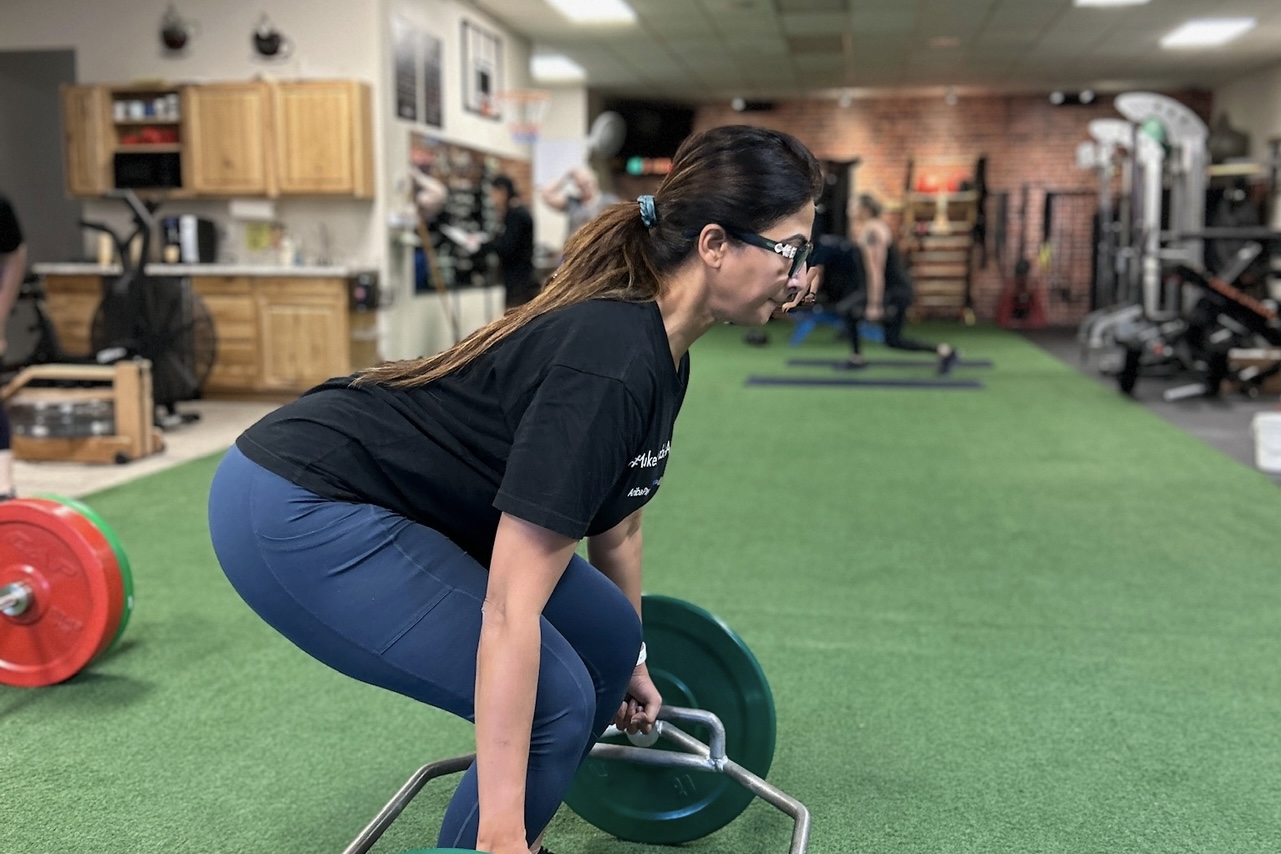
Here's what good squat form looks like:
Feet shoulder-width apart, toes slightly turned out
Weight in your heels, not your toes
Sit back into your hips like you're sitting in a chair
Knees track over your toes—they shouldn't cave inward
Core engaged to keep your torso upright
If you're still experiencing pain with proper form, it might be time to modify the movement:
TRX-Assisted Squats – Use suspension straps to take some load off your knees while you build strength and stability
Box Squats – Squat down to a box or bench to control depth and reduce knee stress
Goblet Squats – Holding a weight in front keeps you more upright and reduces forward knee travel
The goal isn't to avoid squats forever—it's to find a variation that lets you train pain-free while you build the strength and mobility you need.
3. Build Hip and Ankle Mobility
Remember: knee pain is often a hip or ankle problem in disguise.
If your hips are tight, your knees compensate. If your ankles are stiff, your knees take the hit.
Work on:
Hip flexor stretches to improve hip mobility
Ankle mobility drills (like ankle rocks or calf stretches) to allow better squat depth
Glute activation exercises (like clamshells or banded walks) to ensure your hips are doing their job
When your hips and ankles move better, your knees feel better.
4. Progress Gradually (Don't Jump Back In at Full Speed)
If you haven't trained in years, your knees need time to adapt.
Start with 2-3 sessions per week. Focus on bodyweight or light resistance. Prioritize form over intensity.
As your strength and stability improve, you can gradually add weight and complexity. But rushing the process is how people get hurt.
When to Get Help (And Why Coaching Matters)

Here's the reality: you don't know what you don't know.
You don't know if your squat form is putting stress on your knees. You don't know which exercises are safe for your specific situation. You don't know if your pain is coming from weak glutes, tight hips, or poor ankle mobility.
A good coach does.
At Catalyst Fitness, our expert coaches customize every workout based on your body—your limitations, your goals, your pain points. If your knees hurt during squats, we modify the movement. If you need to build strength in your hamstrings and glutes before loading your knees, that's where we start.
We also work alongside clients who are seeing physical therapists. If your PT gives you exercises to do during your warm-up or cool-down, we make sure those get incorporated into your training. We don't replace physical therapy—we complement it by making sure you're moving well and building strength safely.
And because we use a semi-private training model with a 7:1 client-to-trainer ratio, you're not left guessing. We're watching every rep, correcting your form in real time, and adjusting your program as you progress.
If you're dealing with chronic knee pain or need a formal assessment, we can also refer you to Dr. Tara Loveland, a physical therapist who rents space near our gym and specializes in helping active adults address pain and movement issues. You can learn more at her by visiting her website www.revitalize-athletics.com/
The Bottom Line: Your Knees Aren't the Problem—Your Training Is
If your knees hurt during workouts, it's not because you're too old or because you have "bad knees."
It's because the muscles around your knees are weak, your movement patterns are off, or you're doing too much too soon without proper guidance.
The solution? Build strength in the right places, fix your form, modify movements intelligently, and train with a plan—not just random workouts from the internet.
Your knees can handle strength training. They just need the right approach.
Ready to Train Pain-Free?
If you're tired of avoiding leg workouts because your knees hurt, we can help.
At Catalyst Fitness in Lakewood, Colorado, we specialize in working with adults over 40 who are dealing with injuries, limitations, and pain. We'll customize your workouts, teach you proper form, and give you a plan that actually works for your body—not some generic program that ignores your knees.
Book a free consultation here and let's figure out what's going on with your knees and how we can help you train pain-free.
