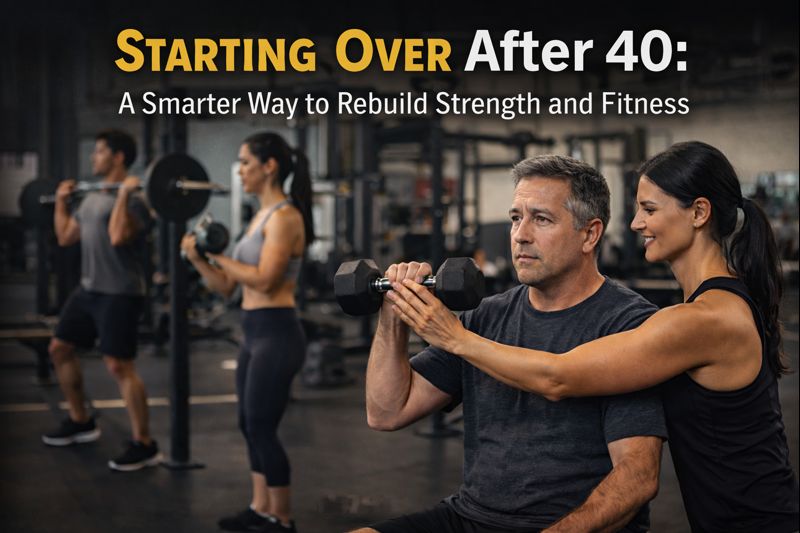
How to Start Strength Training Over 40 When You Haven't Worked Out in Years | Catalyst Fitness
How to start working out after 40
You know you need to do something.
You feel weaker than you used to be. More tired. Maybe a little softer around the middle. Your back aches after a long day. Your knees creak when you stand up. And deep down, you know that if you don't start moving soon, it's only going to get harder.
But the idea of walking into a gym after years away? Terrifying.
You don't know where to start. You're worried about getting hurt. You picture yourself surrounded by 25-year-olds who know exactly what they're doing while you're fumbling with dumbbells, trying to remember how anything works.
So you wait. You tell yourself you'll start "when things calm down" or "after the holidays" or "once you figure out a plan."
Here's the truth: starting over is harder than starting fresh. But it's not impossible. And if you approach it the right way, you can rebuild strength, confidence, and momentum faster than you think.
Let's talk about how to actually do it—without getting hurt, without wasting time, and without feeling like an idiot.
Why Starting Over Feels So Hard (And Why That's Normal)
If you haven't worked out in years, your body isn't the same as it was the last time you were in a gym. That's not a judgment—it's just biology.
Your joints are stiffer. Your muscles have lost some of their strength and coordination. Your recovery takes longer. And if you're over 40, your body doesn't bounce back from mistakes the way it did when you were younger.

This is why you can't just "jump back in" the way you used to. The workout that worked for you at 30 might wreck you at 45. The bootcamp class that sounds motivating might leave you injured and discouraged after two weeks.
None of this means you're broken. It just means you need a smarter approach.
And here's the good news: once you understand how to work with your body instead of against it, progress comes fast. You don't need to spend years rebuilding. You just need to start with the right foundation.
The 3 Biggest Mistakes People Make When Getting Back Into Fitness
Most people fail not because they're lazy or unmotivated, but because they make one of these three mistakes right out of the gate:
Mistake #1: Doing Too Much Too Soon
You're excited. You're motivated. So you sign up for a 6 AM bootcamp class, commit to going five days a week, and go all-in on day one.
By week two, you're sore, exhausted, and dreading your alarm. By week three, you've pulled something and you're back on the couch.
Sound familiar?
When you haven't trained in years, your body needs time to adapt. Muscles, tendons, ligaments—they all need to rebuild their capacity gradually. If you push too hard too fast, you'll either get hurt or burn out before you build any real momentum.
Mistake #2: Choosing the Wrong Training Style
Not all workouts are created equal, especially if you're over 40 and haven't trained in a while.
High-intensity bootcamp classes might look fun, but they're built for people who already have a foundation of strength and conditioning. If you don't, you'll spend the whole class trying to keep up, sacrificing form, and increasing your risk of injury.
Random YouTube videos and at-home programs? Same problem. They're designed for the masses, not for you—your body, your limitations, your goals.
And big box gyms? Plenty of equipment, zero guidance. You're left guessing what to do, how much weight to use, and whether you're even doing it right.
Mistake #3: Not Having a Plan (or Accountability)
Motivation is great. But motivation fades.
What happens when life gets busy? When you have a rough week at work? When you don't see results as fast as you hoped?
Without a plan and without someone holding you accountable, it's easy to skip a session. Then another. Then another. And before you know it, you're right back where you started.

What Actually Works: The Smart Way to Start Strength Training After 40
If you want to rebuild strength, stay consistent, and avoid injury, here's what you need to do differently:
1. Start with Strength, Not Cardio
Most people think they need to "get in shape" before they start lifting weights. So they spend weeks on the treadmill or elliptical, hoping to lose a few pounds first.
But here's the problem: cardio doesn't make you stronger. It doesn't rebuild the muscle you've lost. And it doesn't protect your joints or improve your posture.
Strength training does all of that.
When you build strength, everything else gets easier. You move better. You feel more confident. You burn more calories at rest. And you reduce your risk of injury in everyday life.
You don't need to be "in shape" to start lifting. You just need to start with the right exercises, the right load, and the right coaching.
2. Focus on Movement Quality Over Intensity
When you're starting over, the goal isn't to go as hard as possible. It's to move well.
That means learning proper form. Understanding how your body moves. Building control and stability before you add heavy weight or high intensity.
This is where most gyms fail people over 40. They prioritize intensity and speed over technique. They assume everyone can (and should) do the same workout. And when someone gets hurt, they chalk it up to "bad luck" or "getting older."
But it's not bad luck. It's bad coaching.
If you focus on quality first, you'll build a foundation that keeps you training for years—not weeks.
3. Work with a Coach Who Understands Your Body
Here's the reality: you don't know what you don't know.
You don't know if your squat form is putting stress on your knees. You don't know if your shoulder mobility is limiting your pressing strength. You don't know if the exercise you saw on Instagram is actually appropriate for your body right now.
A good coach does.
A good coach meets you where you are—not where you think you should be. They customize your workouts based on your injuries, limitations, and goals. They track your progress so you can see that you're getting stronger, even when motivation fades.
And most importantly, they hold you accountable when life gets busy and it's tempting to skip a session.
4. Track Your Progress (Because Motivation Won't Last)
Let's be honest: some days, you're not going to feel motivated. Some days, you're going to be tired, stressed, or just not in the mood.
That's normal.
But if you can look back and see that you're lifting 10 pounds more than you were a month ago, or that your plank hold is 20 seconds longer, or that your knees don't hurt during squats anymore—that's what keeps you going.
Progress is proof. And proof beats motivation every time.
What Your First 4 Weeks Should Look Like
If you're starting over, here's a realistic roadmap for your first month:
Weeks 1-2: Learning and Consistency
Goal: Show up 2-3 times per week. Focus on learning basic movement patterns (squat, hinge, press, pull).
Weight: Light. You should feel like you could do more—that's the point.
What to expect: Some soreness (normal). A little awkward (also normal). But you'll start feeling more confident in the gym.

Weeks 3-4: Adding Load and Building Momentum
Goal: Keep showing up 2-3 times per week. Start adding weight as your form improves.
Weight: Moderate. You should feel challenged, but still in control.
What to expect: You'll feel stronger. Movements will start to feel more natural. You'll notice small wins—lifting something at home feels easier, or your posture improves.
By the end of your first month, you won't be "in the best shape of your life." But you will have built a foundation. You'll have proven to yourself that you can do this. And you'll be ready to keep going.
Ready to Stop Thinking About It and Actually Start?
Look, you can read every article on the internet about how to start working out again. You can watch every YouTube video. You can tell yourself "I'll figure it out" for another six months.
Or you can just start.
If you're ready to stop overthinking and start moving, we can help. At Catalyst Fitness, we specialize in working with adults over 40 who are getting back into training after years away. We'll customize your workouts, teach you proper form, and give you a plan that actually fits your life—not some cookie-cutter program that ignores your limitations.
No pressure. No sales pitch. Just a real conversation about what you need and how we can help.
Book a free consultation here and let's map out exactly what your first month should look like.
